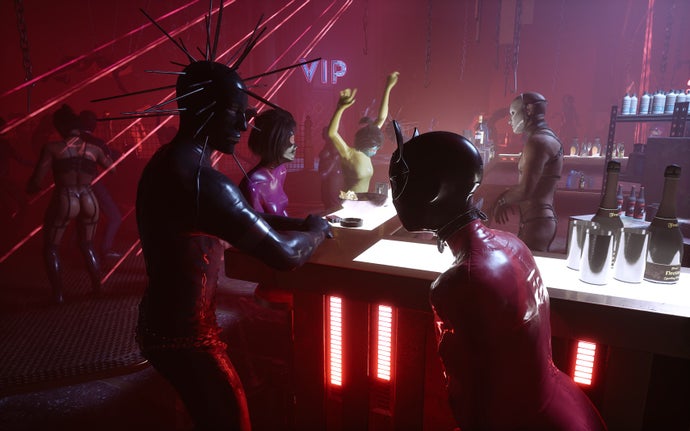
There’s an intriguing irony at the hEart of Saber Interactive’s Hellraiser: Revival, and it has nothing to do with puzzle boxes or pin-faced Cenobites. Instead, it’s the game’s early visit to a bondage club—one presented with such grounded, matter-of-fact authenticity that it ends up making the rest of this Clive Barker adaptation feel, well, a little embarrassing.
A Kink Club Played Completely Straight
Early in Hellraiser: Revival, players step inside a fetish club that appears to be modelled closely on real-world venues. The details ring true: the atmosphere, the clientele, the unspoken etiquette of a space where consenting adults explore their desires. As Rock Paper Shotgun’s writer candidly admits, they aren’t the right person to judge whether the game fully succeeds in distinguishing consensually practised fetish from the otherworldly torture the Hellraiser franchise is famous for. But the club’s grounded presentation accomplishes something else entirely—it exposes just how ridiculous the surrounding horror theatrics really are.
Contrast Is Everything
When a game depicts a real place with real care, the illusion carries weight. You believe in that club. So when the narrative then pivots to demons in leather with nails through their skulls, the tonal whiplash becomes impossible to ignore. The Cenobites, once genuinely transgressive in Barker’s 1987 film, suddenly look like cartoonish spook-house mascots next to a venue that actual people might visit on a Friday night.
The Bigger Problem With ‘Sexual Themes’ in Horror Games
This is where Hellraiser: Revival becomes a useful case study for the entire horror genre. For decades, violent horror videogames have slapped the “sexual themes” descriptor on their content while treating sexuality as decoration—something lurid to spice up a scare rather than an authentic part of human experience. The result is often a strange adolescent mishmash: titillation and gore jumbled together with no coherent perspective on either.
By grounding one corner of its world in reality, Hellraiser: Revival accidentally highlights how hollow that approach usually is. If your bondage club feels like a place that could exist, then your dimension-hopping pain demons need to earn their menace—and clumsy “sexual themes” window dressing simply won’t cut it. The comparison flattens the horror rather than amplifying it.
Clive Barker’s Original Vision Deserves Better
What makes this particularly pointed is the source material. Clive Barker’s original Hellraiser was provocative precisely because it blurred lines with intention—pleasure and pain, desire and dread, all filtered through genuinely adult sensibilities. A game adaptation that includes a realistic fetish club but can’t reconcile it with its supernatural horror suggests the developers understood the aesthetics without fully grasping the philosophy underneath. The effect is a game that gestures at Barker’s daring while quietly underlining its own awkwardness.
An Accidental Piece of Games Criticism
Perhaps the most interesting takeaway is that the club sequence works as unintentional commentary. Whatever Saber Interactive intended, placing authenticity beside artifice gives players a measuring stick. It’s a rare thing: a game accidentally critiquing its own genre by simply doing one thing honestly.
For horror fans curious to judge the contrast themselves, Hellraiser: Revival is worth a look—and if you’re planning to pick it up, you can check out TURGAME.com for game codes, digital gift cards and wallet top-ups at competitive prices to fund your next nightmare.
Source
Source: Rock Paper Shotgun