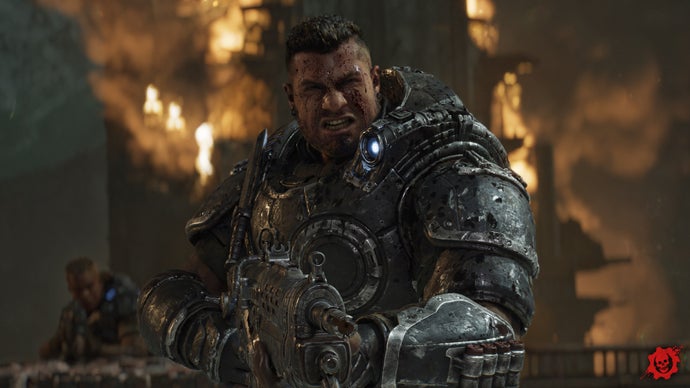
Every Xbox first-party studio faces the same unspoken challenge: your game has to shine on both the Xbox Series X and its smaller sibling, the Series S. For Gears of War: E-Day, developer The Coalition seems to have found an elegant answer to the Series S’ biggest weakness — and it’s a solution that could ripple across the entire Xbox ecosystem.
The Xbox Series S Memory Problem, Explained
On paper, the gap between the two consoles is usually framed in terms of GPU power, but the real headache for developers is memory. The Xbox Series X ships with 16GB of GDDR6 RAM, of which roughly 13.5GB is available to games. The Series S, by contrast, offers just 10GB in total, leaving developers with around 8GB of usable memory once the operating system takes its share.
Why RAM Is the Real Bottleneck
Modern action games are memory-hungry beasts. High-resolution textures, enemy AI, physics simulations and sprawling level geometry all compete for that limited pool. When RAM runs out, developers are forced to cut texture quality, shrink draw distances or simplify scenes — which is why some cross-generation titles have struggled to hit feature parity on the cheaper console.
How The Coalition’s SSD Solution Works
Rather than accepting the Series S’ memory ceiling as a hard limit, The Coalition has effectively turned the console’s fast internal NVMe SSD into an extension of its RAM. By streaming game data from the SSD so aggressively and intelligently, the studio reduces how much information needs to sit in memory at any given moment. In practical terms, the game behaves as though it has access to more memory than the hardware physically contains.
It’s a philosophy that echoes the streaming-first thinking behind the PS5’s architecture and Microsoft’s own DirectStorage API on PC — but applied with first-party precision to squeeze every last drop out of the affordable Xbox machine.
A Technique Other Xbox Games Could Copy
Here’s the exciting part for Xbox owners: this approach isn’t exclusive to Gears. Since every Xbox Series console ships with the same speedy internal SSD, the memory-augmentation techniques The Coalition has built for E-Day could theoretically be adopted by other first-party studios and even third-party developers. If that happens, the Series S’ reputation as the bottleneck holding this generation back could slowly fade.
What This Means for Gears of War: E-Day Players
Gears of War: E-Day is a bold project for The Coalition — a prequel set during the catastrophic Emergence Day, following a young Marcus Fenix and Dominic Santiago as the Locust Horde tears through Sera. Built on Unreal Engine 5, the game promises massive destruction and screen-filling swarms of enemies, exactly the kind of spectacle that typically punishes lower-specced hardware.
That makes the SSD breakthrough especially significant. If E-Day can deliver its cinematic carnage at a stable frame rate on Series S, it would send a strong message that Microsoft’s smallest console still has untapped headroom — and that clever engineering matters more than raw specs.
It also reflects well on Microsoft’s parity mandate. Requiring every game to run on Series S has drawn criticism this generation, but constraints often breed innovation, and this is a textbook example.
Get Ready for Emergence Day
While we wait for a final release date, there’s never been a better time to top up your Xbox wallet. You can pick up Xbox gift cards and game codes at TURGAME.com at competitive prices, so you’re ready to pre-order Gears of War: E-Day the moment it drops.
Source: Eurogamer