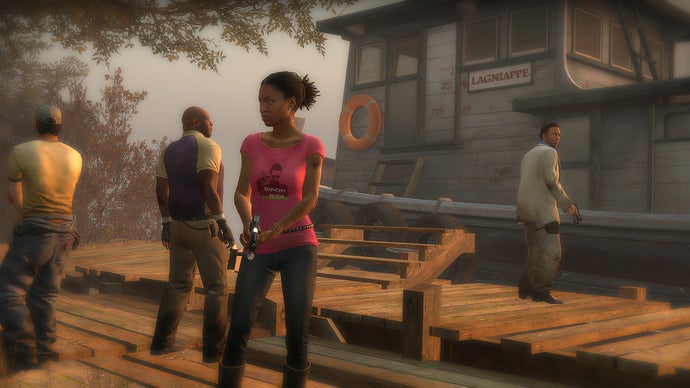
Gaming history is packed with clever marketing stunts, but few are as gloriously shameless as the one Valve pulled with Left 4 Dead 2. When the Entertainment Software Rating Board (ESRB) refused to let the studio officially release the game’s cinematic trailer, Valve didn’t tone down the gore or shelve the footage. Instead, the trailer mysteriously “leaked” onto the internet — and Valve walked away whistling, technically innocent, while fans devoured every blood-soaked second.
The Trailer the ESRB Didn’t Want You to See
Left 4 Dead 2 launched in November 2009 as the lightning-fast sequel to Valve’s hit co-op zombie shooter. Set across the American Deep South, from Savannah to New Orleans, it introduced four new survivors — Coach, Ellis, Nick, and Rochelle — plus an arsenal of melee weapons including katanas, chainsaws, cricket bats, and the legendary frying pan.
The cinematic trailer captured all of that carnage in loving detail: severed limbs, infected sliced clean in half, blood spraying across abandoned carnival grounds. It was a perfect distillation of the game’s over-the-top violence — and, as far as the ESRB was concerned, completely unacceptable as an official piece of marketing.
Why the ESRB Draws a Hard Line on Marketing
Here’s the twist many gamers don’t realize: a game’s rating and its advertising are judged by different rulebooks. Left 4 Dead 2 shipped with a Mature rating, which was fine for the product itself. But the ESRB’s advertising guidelines place strict limits on how graphic promotional material can be, since trailers circulate freely online where anyone — including younger audiences — can watch them. A hyper-violent trailer for an M-rated game was, in the board’s eyes, a step too far.
Valve’s Loophole: Just “Leak” It
Faced with rejection, Valve found a loophole worthy of a heist movie. If the studio didn’t officially release the trailer, it wasn’t official marketing — and if it wasn’t official marketing, the ESRB’s advertising rules simply didn’t apply. So the footage duly “found its way” online as a leak, and Valve could plausibly deny involvement while the internet did the rest.
As Valve’s developers have recounted over the years, the whole thing was done with a wink. Everyone knew exactly where the trailer came from, and nobody cared. The footage spread like wildfire precisely because it felt forbidden.
Why the “Leak” Was Accidental Marketing Genius
In hindsight, Valve turned a regulatory roadblock into a publicity windfall. A leaked trailer generates far more buzz than an official one — it carries an aura of authenticity and mild transgression that polished marketing can never replicate. The ESRB’s attempt to rein in the trailer arguably guaranteed it a far bigger audience than a standard release ever would have.
It also fed perfectly into Valve’s late-2000s image as the rebellious, player-first studio. For a company already beloved for ignoring industry conventions, “leaking” its own trailer read less like a rules violation and more like a prank with the entire gaming community in on the joke.
A Legacy That Refuses to Die
More than fifteen years later, Left 4 Dead 2 remains one of the most beloved co-op shooters ever made, still boasting a healthy player base on Steam thanks to its modding scene and timeless four-player chaos. The leaked-trailer saga has become a cherished piece of Valve lore — proof that sometimes the best marketing move is pretending you didn’t market at all.
Want to experience the carnage for yourself? Pick up a Steam gift card or game codes at TURGAME.com and jump into Left 4 Dead 2 with three friends — frying pan highly recommended.
Source: Rock Paper Shotgun
Source: Rock Paper Shotgun